Overview
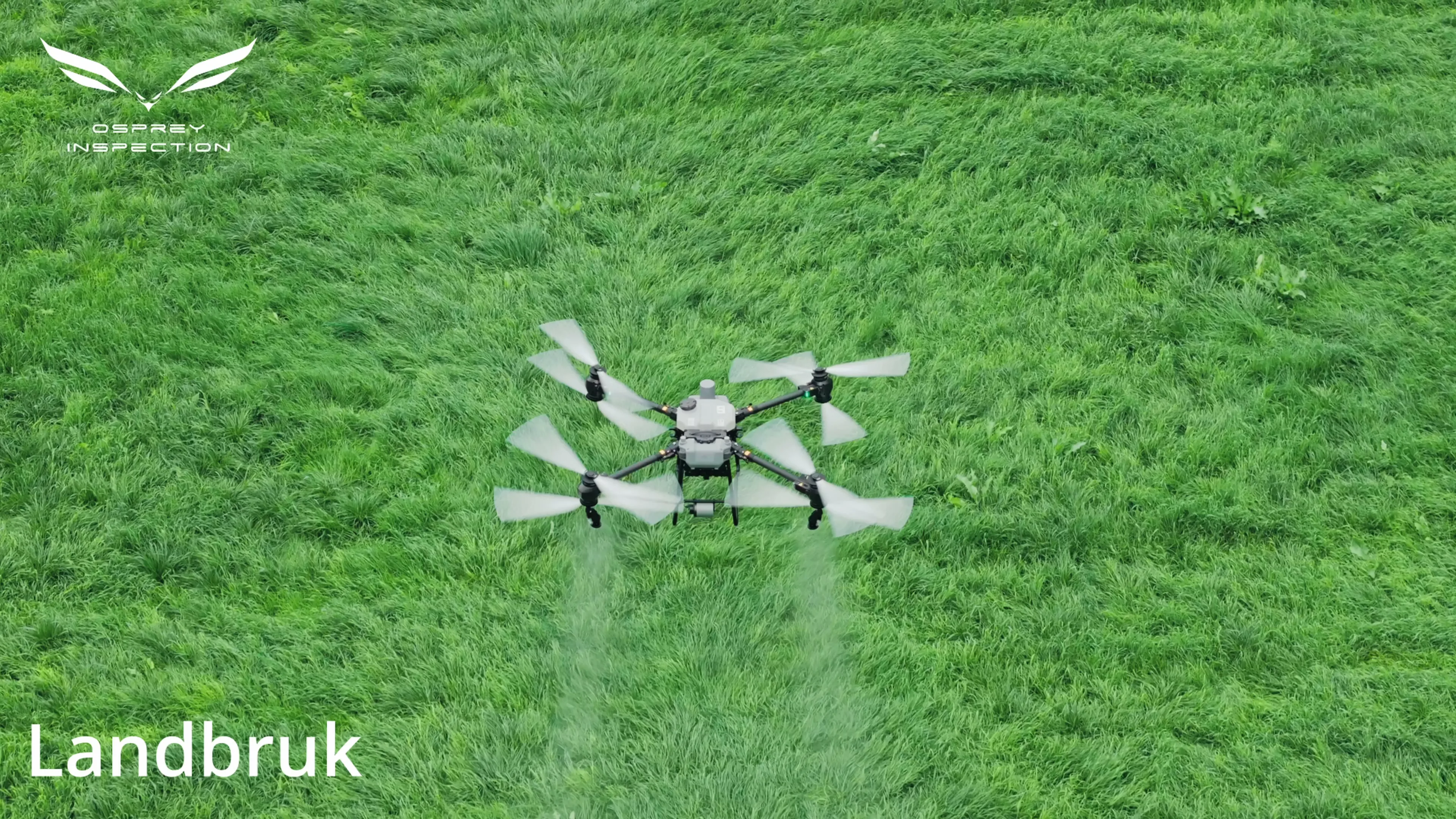
Osprey Inspection ran the first field test of the DJI Agras agricultural drone in Norway, working with Romvesen and NIBIO (the Norwegian Institute of Bioeconomy Research). Agras is built for precision crop work: spraying, granular spreading, high-volume field coverage. We wanted to see how it holds up under Norwegian farming conditions.
About the Agras platform
DJI Agras is a heavy-lift agricultural UAV built for precision spraying and granular spreading. Centimetre-grade RTK positioning, terrain-following radar and intelligent flow control let it apply liquid or solid product at a controlled rate over fields with uneven ground. Tractors can't always follow: wet soil, slopes, terraced plots. Agras handles that terrain without compacting the soil.
Partners
Scope of the test
- First documented Agras field deployment under Norwegian conditions
- Precision spraying performance: droplet size, swath consistency, drift control
- Granular-spreading mode for fertiliser and seed application
- Terrain-following capability across uneven Norwegian agricultural topography
- Coverage rate and battery-cycle economics for typical Norwegian field sizes
Why this matters
Norwegian farms deal with small, fragmented fields, steep terrain, short growing windows, and strict rules on spray drift near watercourses. A drone can apply product precisely without the soil damage ground equipment often causes on wet or sloped land. This test gave us real performance numbers on how Agras fits into Norwegian farm work.
Carried out with Romvesen and NIBIO. Footage from the test is shown above.